

Last Updated: October, 2026
Why Is Seller Adoption Critical to AI-Powered Sales Transformation?
The rate at which your sellers adopt sales technology—or how quickly they embrace new tech tools and how deeply they integrate them into their daily selling motions—can make or break not just your revenue goals, but your B2B sales team’s quotas, your ability to retain top talent, your customer experience, and your budget.
Yet there are overwhelming tech tool requirements for sales reps. Salesforce found that B2B sales teams use an average of 10 tools to close deals, and 66% of sales reps said they’re drowning in sales tools.
What’s Your Seller Adoption of Sales Tech Rate? Use our Sales Tech Stack Maturity Matrix to find out.
KEY TAKEAWAYS
What Are the Best Practices for AI and Sales Technology Adoption?
- Start with process before technology
- Train sellers continuously, intentionally
- Measure adoption rates and usage
- Connect technology to business outcomes
- Incorporate AI and automation thoughtfully
- Gather seller feedback regularly
How Many Sales Teams Successfully Adopt New AI and Sales Technology?
At the same time, according to Outreach, the average seller adoption rate for sales tech is just 30%. And that rate doesn’t just apply to peripheral tools. Per SBI, of the 89 companies they surveyed with over $100 billion in revenue, even for top tools, adoption lags, preventing companies from gaining:
- Increased efficiency
- Better data collection
- More informed decision-making
- Improved sales strategy
- Better communication with team members and customers
- Streamlined sales funnels and processes
- Improved customer experiences and relationships
How can you overcome seller adoption roadblocks to unlock all the benefits of a strategically aligned, optimized sales tech stack? In this two-part series, we feature wisdom from a MarketSource expert who is a wizard behind our tech stack curtain and on the front lines with our sellers and customers.
In Part 1, Cory Rossi, our Innovation Manager who who collaborates with our customers to audit and optimize their sales processes to ensure they reach their goals, explores the top culprits and casualties of poor seller tech adoption and offers three remedies.
In Part 2 , Cory reveals key strategies you can deploy today to insulate your team and your sales from the harmful effects of poor seller adoption.
What Happens When Sales Reps Don’t Adopt AI and Sales Technology?
Lack of sales tech adoption doesn’t just hurt sales; it has a profound ripple effect. It can thwart your digital transformation efforts, which can impair customer acquisition, existing customer satisfaction, your ability to serve customers efficiently, seller confidence, and talent retention.
The top 3 areas that suffer the most from obstructed seller adoption of sales tech are:
Sales Quotas. In a survey conducted by Allego, 76% of companies say poor adoption of sales tools is the main reason sellers miss their quotas. Tech should empower your sellers and work FOR them, not the other way around. Salespeople who spend too much time on tasks that could be automated or fumbling with tools whose purpose they don’t understand or that they’re not comfortable using are going to close fewer deals.
Sales Efficiency. Gartner’s recent study of 908 B2B salespeople shows that 49% feel overwhelmed by the number of tools required to complete their work, and nearly 60% reported that the introduction of new sales technologies hinders their overall efficiency. That’s because often sales technology fails to meet the detailed daily needs of salespeople—or is “enterprise-” rather than “seller-centric.” And 82% of sales leaders surveyed told Allego that trying to get reps to use the provided sales tools feels like a second job.
Sales ROI. 55% of surveyed sales professionals, including CSOs and sales operations leaders, expressed high regret from recent revenue technology purchases. And companies reported wasting an average of $313,000 over the past two years on sales tools that weren’t fully adopted by reps.
Thankfully, these aren’t inevitable realities. If you feel stuck about seller adoption, you’re not alone, and you don’t have to stay there. We’re here to help you get out of the seller adoption rut.
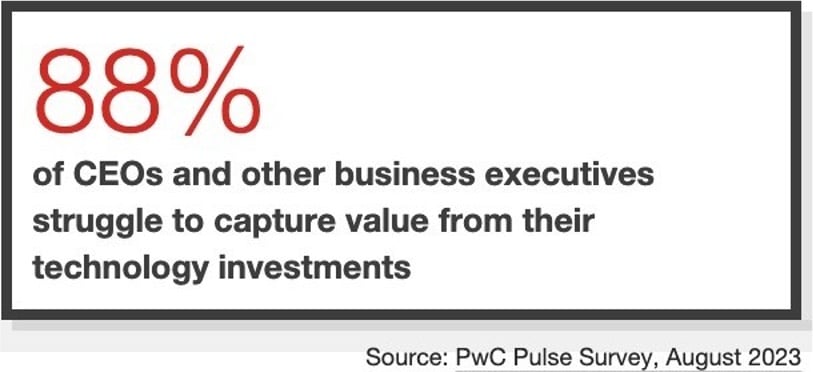
Why Do Sales Teams Struggle to Adopt AI and Sales Technology?
While the configuration of causes may vary slightly by organization, the factors I see undermining seller adoption most often are:
Over-reliance on tech as a panacea or replacement for processes that ensure sales performance
Misalignment of tech and processes
Lack of intentional, thorough seller onboarding and culturally embedded, consistent training
Failure to factor in the human element that will always be part of the selling process
No cycle of continuous improvement and innovation to ensure you have the right tech and it’s working for your sellers—not the other way around
Technology and Sales Processes Are Misaligned
Companies use tech either to provide better information to the user, to make a good process better by automating it, or to streamline a process to drive efficiencies. When the tech doesn’t align with a process, it either lays bare the reality that there was no process at all or exacerbates the underlying process .
A few years ago, there were point solutions available. Now, the convergence we predicted is playing out, which has left a lot of tools in the graveyard. Organizations are abandoning them because they’re not getting the ROI they expected.
The biggest adoption hurdle is a mismatch between the jobs revenue leaders expect tech to accomplish and an either broken or missing underlying sales processes.
This is not a new problem, though. For decades, much of the sales tech on the market has failed to deliver an ROI, either because the hype didn’t deliver (AI deployments, anyone?), or the process and the tech didn’t align. To be effective, tech must support an existing, effective sales process.
CIOs must build a business case to implement any technology, but the promise of their tech of choice often goes unfulfilled. If the tech you invest in isn’t set up to support a specific process, it won’t provide the benefit it was intended to. Alternatively, if the process tries to support the tech, the tech won’t work, or it will increase inefficiencies.
How Can You Improve Seller Adoption of AI and Sales Technology?
As an outsourced sales provider, with so much at stake for our clients, we can’t afford to have poor seller adoption, so we don’t allow it to happen.
As an outsourced sales provider, with so much at stake for our clients, we can’t afford to have poor seller adoption, so we don’t. Ensuring our sellers’ comfort and success with technology is inherent to our strategy and a priority that underpins our sales ecosystem.
To strengthen adoption of sales tech among your sellers:
Align your tech with your sales processes.
We take an engineering approach to sales, which allows us to identify things in the sales process that don’t work—especially upstream—and to align tech with our processes. Our sales ecosystem consists of a series of flows, so if something doesn’t work early in the process, it tends to negatively impact something later in the process. Tech can’t possibly assist in this situation. So, we build the process first, then identify the ideal technology solution to optimize it. For example, coaching is a strategic priority for us—our goal is 95% adoption rate on 1:1 seller coaching.
Implement a continuous improvement process.
We use continuous improvement, a method to find incremental improvement opportunities in processes, skills, and technology, to keep seller adoption in line. It helps us make our salespeople better every single week by surfacing gaps in process so we can streamline them, and making sure they have the right information at the right time in the buying process, which helps them meet their quotas. We use continuous improvement to reduce red time (administrative) and increase green (selling) time. We make sure our tech supports a streamlined sales process, and then we optimize it. This serves the seller more effectively, which makes them not only want to use it but become reliant on it. Continuous improvement also reduces customer churn. We know how hard and expensive it is to acquire a customer, which is why we’re focused on helping our clients keep and grow them.
Let your digital transformation sales strategy guide your tech decisions.
B2B buyers are much more educated now. According to a 2025 report from 6sense, they’re usually roughly 60% through their buying journey before they even contact sales. This reality demands companies engage buyers much earlier in the process—when they’re educating themselves on the solutions to their problems—and in an omnichannel way. Done well, digitalization—which supports the way customers buy—increases customer engagement, boosts salespeople’s skills and performance, and supports a more customer-focused sales approach. But amidst the AI transformation, a lot of companies are struggling with digital transformation, and tech is an instrumental character in that play. Rather than investing in a technology tool and figuring out where it fits, evaluate your digital transformation priorities and select tech solutions that will help you fulfill them.
Ready to talk?
Your tech stack can be an enabler, but only if your sellers use it. Use our Sales Tech Stack Maturity Matrix™ to benchmark where you stand. To take it to the next level…

Author: Cory Rossi
Serving within MarketSource’s commercial business unit’s Innovation Center, Cory is responsible for interacting with internal business leaders and key client stakeholders to understand the program objectives and determine key requirements for sales program design and continuous improvement.

FAQs About AI and Sales Technology Adoption
What is sales technology adoption?
Why do sales teams resist new technology?
Common reasons include inadequate training, poor tool usability, lack of process alignment, and uncertainty about how the technology improves performance.
How does technology adoption impact sales performance?
Higher adoption rates can improve productivity, seller efficiency, data quality, coaching effectiveness, and quota attainment.
What is a good sales technology adoption rate?
While adoption rates vary by organization, many companies struggle to achieve widespread, consistent usage across their sales teams.
How can organizations improve seller adoption of sales technology?
Organizations can improve adoption by aligning technology with sales processes, providing ongoing coaching and training, and continuously gauging and improving the seller experience.
Want More Sales?
Subscribe now to receive occasional emails with insights that help you accelerate profitable growth, risk reduction, market expansion, and revenue velocity.
What are you waiting for?