

Last Updated: October, 2026
The challenge for B2B sales organizations isn’t collecting more customer data. It’s knowing what to do with it. A strong business intelligence strategy turns disconnected data points into actionable insights that reveal customer needs, identify growth opportunities, and guide smarter sales decisions. When data becomes intelligence, it can become a powerful engine for more predictable, resilient revenue growth.
A firing-on-all-cylinders data strategy is an essential tool to outperforming sellers. A McKinsey & Co. report, How Top Performers Outpace Peers in Sales Productivity, explains it this way: “Leaders further realize that they need to focus on the seller experience. Instead of toggling between systems as many reps are obliged to do today, top-performing organizations integrate customer data and analytics into a single pane of glass, and they work with sellers to ensure account and deal-level insights are presented in user-friendly ways. These efforts have increased seller adoption, which in turn has improved productivity, conversion, and sales.” AI serves as the connective layer that brings this vision to life, automating the synthesis of CRM notes, account intelligence, market insights, and meeting preparation into a single, actionable call card that equips sellers with the right information at the right time.
To set your organization up for repeatable, predictable growth, solidifying your data strategy right now is not just wise; it’s a prerequisite.
This is where business intelligence comes in.
KEY TAKEAWAYS
Business intelligence turns data into action. Its value comes from connecting customer, sales, operational, and market data to decisions that improve performance and revenue.
Reliable, unified data is the foundation. Clean, consistent data gives BI tools and AI systems the context needed to produce trustworthy insights.
AI accelerates analysis, but strategy and human expertise remain essential. AI can help unify information, surface patterns, and deliver timely recommendations, while analysts translate those findings into business action.
Insights must reach sellers where they work. Embedding analytics into everyday sales tools and workflows improves adoption and makes intelligence easier to act on.
Revenue resilience depends on continuous action. Organizations create more value when they monitor results, refine processes, and respond quickly to changing customer and market conditions.
Our business intelligence team helps our clients achieve more sales, faster than they thought possible. Put them to work for you.
What Is Business Intelligence and How Does It Support AI?
At its core, business intelligence is a technology-driven process for ingesting and analyzing data to deliver actionable insights to stakeholders that can inform their business decisions.
Business intelligence also creates the data foundation that makes effective AI possible, while AI extends the value of BI by accelerating analysis and turning complex data into more timely, predictive, and actionable insights.
At MarketSource, supported by revenue acceleration-oriented people, processes, and technology, our extensive BI team is charged with creating a comprehensive picture of our clients’ businesses, equipping them to make strategic business decisions. Our business intelligence approach consists of:
Salesforce Analysts who customize Salesforce instances to suit our clients’ environments, achieve their KPIs, and capture the best data
Geographical Information System (GIS) Analysts who analyze location data to offer strategic insights that help clients visualize and understand the market, customer behavior, and the competition, determine where to grow their business, and visualize and manage operations
Instructional Designers who create and deliver training playbooks to ensure alignment on proper data collection from sales teams
Business Process Engineers who map the client’s processes to relevant data
Business Analysts who assess and analyze the data and monitor and measure results that inform sales optimization strategies
Extensive Sales Enablement Technology Stack. For us, sales technology is not merely an enabler but a foundation, integral to our effectiveness, efficiency, and optimization. We select and align the very best technologies for each client’s needs, placing the right technologies in the right place in the sales process to make every sales rep as productive and efficient as possible.
AI serves as the connective layer that brings this vision to life, automating the synthesis of CRM notes, account intelligence, market insights, and meeting preparation into a single, actionable call card that equips our sellers with the right information at the right time.
Each of these elements contributes to our successful, holistic business intelligence approach, allowing us to do more than just collect and regurgitate data. We go beyond reporting to tell a story—a comprehensive, optimal, actionable story that helps our clients understand where and how to increase revenue, improve sales efficiencies, and outperform the competition.
We do this by delivering near real-time data and producing engaging and meaningful dashboards and reports, which empower our clients with data views that allow them to make both macro- and micro-level decisions.
“We don’t just synthesize data and report; we tell a story.”
– Ryan Palmore, Director of Reporting and Analytics for MarketSource
Why Are Business Intelligence and AI Important for B2B Sales?
In its 10th Annual Sales & Marketing Data Report, Dun & Bradstreet’s Senior Director of Product Management, George C. L’Hereux, Jr., said, “Going forward, we need to think of data as the lingua franca of business… It’s how we make decisions. It’s how we talk to one another. And it’s how we’re going to be able to measure our success or our failure.”
What does that look like? Making B2B customer data actionable drives profits and growth by:
- Giving you a unified, unbiased, accurate view of your customers’ health
- Providing context to engage effectively with customers across their journey
- Delivering insights to reduce customer churn
- Helping sales managers identify opportunities at the customer level for new product sales or higher margins, which can lead to greater renewal rates
- Empowering you to uncover and diagnose customer journey and sales process inefficiencies
- Reducing sellers’ administrative time
- Equipping sales reps to have successful negotiations
- Helping you drive profitable sales and generate sustained performance
- Identifying growth opportunities
- Pinpointing which levers of the business to adjust and optimize, which can foster resilience during uncertain times
Says Tech Target, “Without BI, organizations can’t readily take advantage of data-driven decision-making. Instead, executives and workers are primarily left to base important business decisions on other factors, such as accumulated knowledge, previous experiences, intuition and gut feelings. While those methods can result in good decisions, they’re also fraught with the potential for errors and missteps because of the lack of data underpinning them.”
What Are the Business Benefits of BI and AI-Ready Data?
|
|
|
|
|
|
|
|
As the authors of the Harvard Business Review article, Leveraging Growth Analytics for B2B, wisely point out, “The amount of data available for decision making and performance monitoring is growing constantly. The same is true for the potency of analytics and artificial intelligence. But not all companies are taking full advantage of data and analytics to drive growth.”
If you’re dealing with many manual processes, multiple data sources, and typically just report on the data without deep analysis, building a highly functioning BI practice can be overwhelming. AI accelerates this process by automating data preparation, unifying disparate data sources, and surfacing patterns, relationships, and potential insights, allowing teams to spend less time assembling data and more time translating it into meaningful business action.
Effective BI Tools Need Reliable Data
Like any decision-informing process worth its salt, effective business intelligence depends heavily upon reliable data. We capture data for our clients through a number of technology platforms, customized for each clients’ environment and needs. We’re able to analyze and glean information on every aspect of the sales function, including operations, performance to KPIs, performance of technology, to customer insights.
We then round out the picture by layering in data from our market research and geographic information system (GIS) teams, who generate both market performance, potential, and opportunity insights.
Once we ascertain the 360° view of the client’s business, we we use AI tools and analysts to assemble and synthesize the data to create a profile of the client’s entire story. We then build meaningful dashboards around that story so they—and we—can examine it from all angles. Based on the data, we can make minor tweaks to our processes or technology or make a significant pivot in response to changing market conditions.
5 Strategies for Turning BI and AI-Powered Insights into B2B Sales
Whether you outsource your business intelligence or handle it in house, keep in mind that revenue leaders need much deeper insights than one-off queries or canned reports provide. Make sure your business intelligence team takes a 360° view of all the data impacting your sales performance, from processes and technology, to operations, to customer data.
“The amount of data available for decision making and performance monitoring is growing constantly. The same is true for the potency of analytics and artificial intelligence. But not all companies are taking full advantage of data and analytics to drive growth.” – Harvard Business Review
And remember that the data you receive is only as valuable as it is relevant. Your business intelligence team should be able to drive better outcomes by continuously analyzing data, delivering actionable reporting solutions, and be supported by a large-scale analytics technology stack that leverages a robust data infrastructure, automation pipelines, and visualization tools that enable AI-driven methodologies for efficiency and insights.
To optimize the benefits of business intelligence, follow these five strategies:
1. Seamlessly embed analytics tools into your day-to-day sales processes. Only 21 percent of companies McKinsey studied systematically embed insights from analytics into the tools sellers use every day. This leads to suboptimal adoption and incomplete feedback—as well as slow improvement—for analytics models. Making analytics inherent to your sales processes will allow you to quickly act on insights and recommendations.
2. Ensure you are relying on both descriptive and predictive data strategies and tools. Past and future perspectives are essential to charting a strategic path forward that enables resilient revenue growth. Make sure your BI team is addressing both to paint a complete picture.
3. Identify areas where data and analytics can make the biggest difference. Whether related to new market opportunities, seller optimization, or overcoming stubborn challenges to customer adoption, BI teams need to know your sales goals and priorities in order to deliver relevant insights.
4. Manage your sales team and performance based upon data, not subjective experience or intuition. While observations can be helpful in coaching your sellers, data is reliably scrutable and allows you to pinpoint sellers’ specific areas of weakness so you can remedy them without incurring unnecessary turnover.
5. Act on what your data tells you. Don’t let your BI team’s findings and recommendations be in vain. Weigh their guidance against what works best for your business and has the greatest opportunity to drive revenue and deliver ROI and make plans to implement.
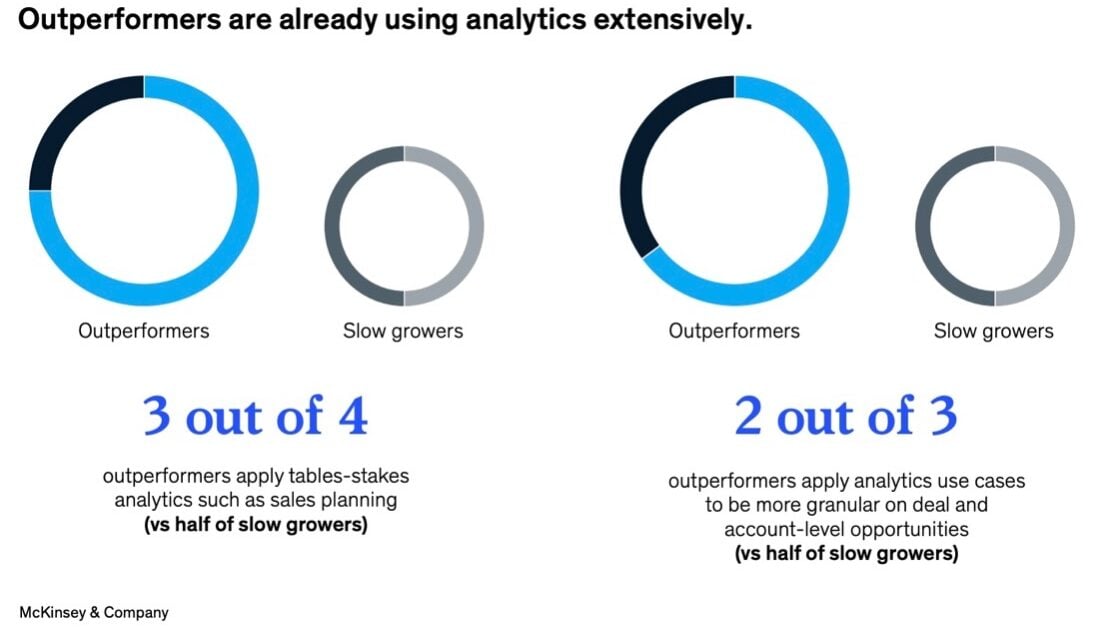
Says McKinsey, “While forward-thinking companies are using analytical insights to find new customers, others are struggling to adapt to the current digital-first engagement model, which has shifted the power from seller to customer. Customers are doing their own research online and finding out about a company or product before the seller has an opportunity to pitch it, whether it concerns transactional items or complex systems. Companies are therefore turning to analytics to help them predict more accurately who their potential customers are, their pain points and their next moves, and then proactively engage with them as early as possible. Outperformers—here defined as companies that beat the average growth rate of their sector—already use analytics extensively and successfully. Players with strong customer analytics are 1.5 times more likely to grow fast and can drive increases in earnings upwards of 15–25 percent.”
You can become on of them.
Ready to talk?

Author: Ryan Palmore
As Director of Analytics, Ryan brings over 15 years of experience driving innovative, enterprise‑level analytics strategies that enable data‑driven decision‑making and enhance business performance. Ryan manages multidisciplinary teams across Geographic Information Systems (GIS), market research, and business analytics.

Frequently Asked Questions About Business Intelligence and AI
What is business intelligence in B2B sales?
How does business intelligence improve revenue resilience?
What is the relationship between business intelligence and AI?
Why is reliable data important for AI and business intelligence?
What data should a B2B business intelligence strategy include?
How can companies turn BI insights into sales action?
Should a company build or outsource its business intelligence capabilities?
Want More Sales?
Subscribe now to receive occasional emails with insights that help you accelerate profitable growth, risk reduction, market expansion, and revenue velocity.
What are you waiting for?